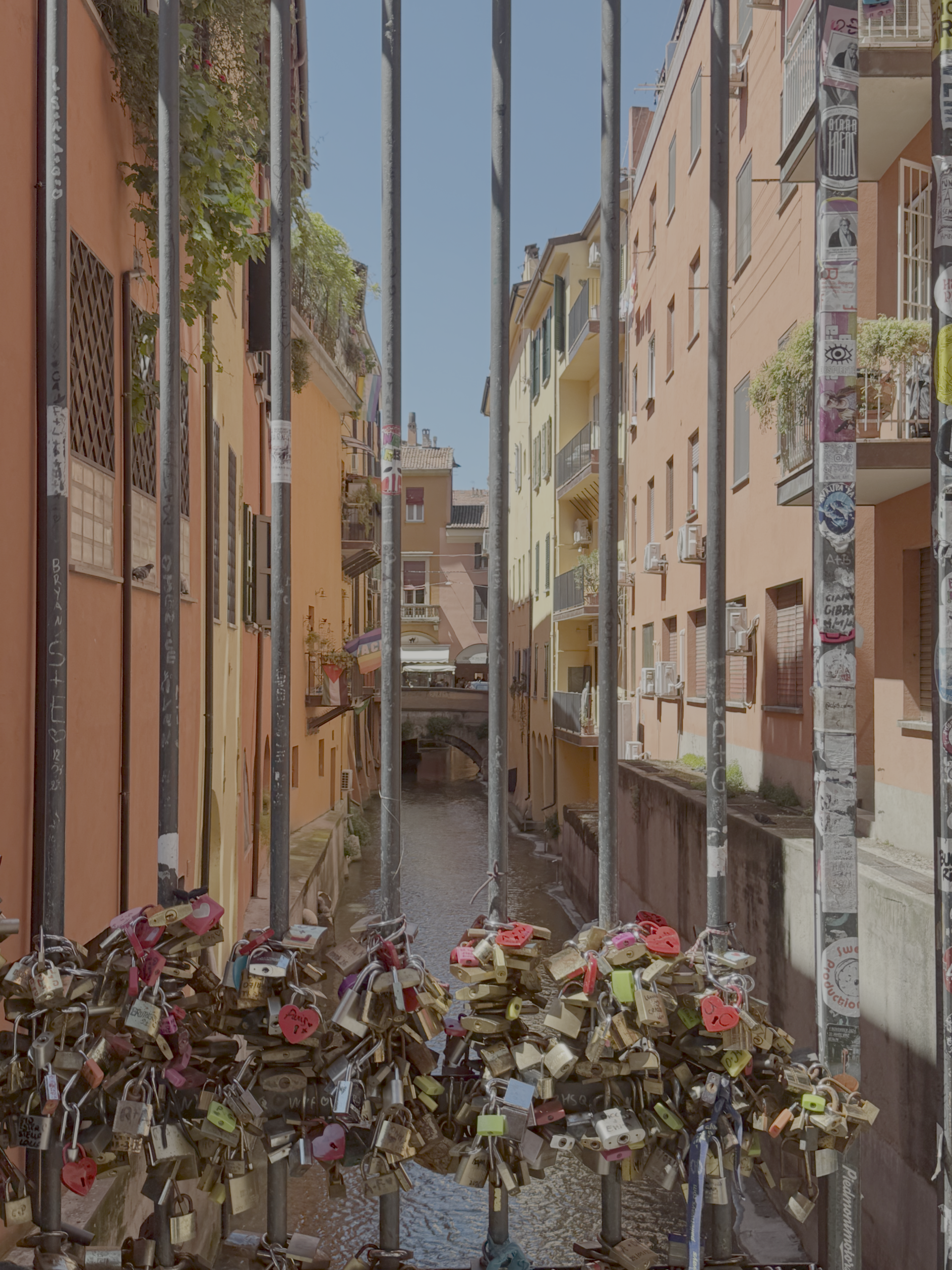
Hey everyone! I am a week away from graduating from Washington and Lee University, and I have spent the last four weeks taking my last ever class in college in Bologna. For the spring semester (W&L works on a trimester system, so the spring term is only four weeks long), I am taking POL 288 Food, Shelter, Space, Voice: Democratic Community in Bologna with my global politics advisor and professor, Robin LeBlanc.
I have loved being in Bologna; it feels very familiar to me, the vehicles, the road signs, the roads themselves, and the vibes of the streets felt like I was back in Mexico, especially in Oaxaca. But learning about its political and social life, and compared to other US cities, it seems like, if I were to live in Bologna, I would feel free to express my political opinions and not be ostracized, especially in today’s political climate, where simply denouncing human rights violations like migration enforcement, the war in Iran, Palestine, and Lebanon, or US imperialism in Venezuela, Cuba, and Bolivia, becomes a left or right political issue.
Bologna, on the other hand, carries and seems to pride itself politically within Italy, particularly through its historical role in anti-fascist resistance and the memory of the Partisans during World War II. Politics remains visible throughout the city. Palestinian flags, “PACE” flags, and left-leaning political banners hang from apartment windows and balconies, and are flown during protests. You can also never walk around Bologna without missing any political graffiti and stickers on the walls and street poles around the city.
With everything I have seen and experienced in Bologna, I also had to work on a “mapping project” for my class that highlighted an “important issue in the construction or maintenance of democratic community.” I considered many possible directions for the mapping project: examining flags and political symbolism throughout the city and how public displays of identity and solidarity shape the urban environment; migration and diversity, particularly in Bolognina, where you can hear people talk in a language other than Italian while walking through the neighborhood; or gentrification, visible in Bolognina with the construction of new glass buildings, and apartments that have gone through the common US greyification of architecture and large commercial developments, like the recently opened Lidl, in a neighborhood filled with “local” produce stores and convenience shops.
Ultimately, however, I decided to focus on Bologna’s porticoes and the distinction between public and semi-public (private) spaces underneath them. The idea for this project emerged from two videos I encountered on TikTok and Instagram. The first was posted on TikTok by César Garrido, Director General de Gobierno y Asuntos Jurídicos de la Alcaldía Miguel Hidalgo, showing him removing benches placed by private businesses on public sidewalks because “they occupied public space” that, according to him, should remain accessible to everyone. The second video was an Instagram reel discussing the concept of “la caguama banquetera,” which is the phenomenon that exists in Mexico, and Latin America, where people use the curb as a place of reunion and a “third place”, to hang out and chat with their friends while enjoying a beer, outside the confines of businesses that require customers to purchase something to occupy a table or seating area. These videos gave me the idea to look into a/the similar phenomenon in Bologna.
When I was completing my observations of porticoes in Bologna, Professor LeBlanc suggested I watch a short documentary by Renzo Renzi, “Guida per camminare all’ombra”, discussing the history and social significance of the porticoes within the city. In the documentary, porticoes are described as spaces tied to public and communal life. Porticoes are “soprattutto, un patrimonio della comunità, una parte della casa regalata ai cittadini” (above all, a community heritage, a part of the house given to the citizens). The documentary also discusses how some families resisted the construction of porticoes because they allowed for “plebe di entrare nei loro palazzi e mescolarsi con loro” (the common people to enter their palaces and mingle with them).
It is important to note that the documentary was produced in 1954, so it reflects an earlier understanding of the city and what porticoes historically represented. Porticoes were not just a walkway that protected pedestrians from rain or sun, but were spaces intended for social interactions and public life.
“Forse questa possibilità di andare tranquilli e coperti gente tra la gente rende il carattere delle persone cordiale e comunicativo. un salotto lungo la strada alimenta Il Gusto della Vita creando continui rapporti con gli altri”
(Perhaps this possibility of walking calmly and covered, people among people, makes the character of the people cordial and communicative. A living room along the road nourishes the taste of life, creating continuous relationships with others)
Today, Bologna has 62 kilometers (39 miles) of porticoes, with 42 kilometers located in the historic center and the remaining 20 kilometers outside the ring road that surrounds the city. With such an extensive number of porticoes, I decided for this mapping project I would focus on the porticoes along Via Dell’Indipendenza and around Piazza Santo Stefano. I selected Via Dell’Indipendenza because the street is constantly filled with pedestrians, tourists, restaurants, bars, shops, and outdoor seating that extends into the porticoes themselves. In contrast, Piazza Santo Stefano offered a different social environment. Although restaurants and bars do occupy parts of the piazza, people frequently use the steps underneath the porticoes as spaces to rest, talk, eat gelato, or simply observe the surrounding area without directly participating in commercial activity.
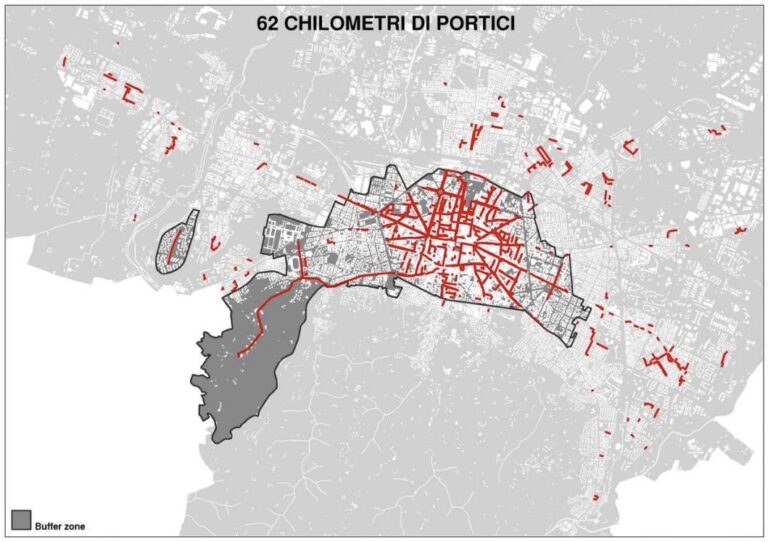
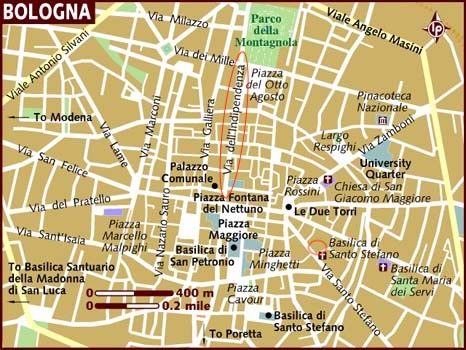
Most of my observations were taken by walking through the area and observing what was happening on the tables and near the seating areas. But I did have the chance to sit down at one of the bars, Bar Onda Marina by Night (Caffe Saccaria). First off, the bar sits on the corner of Via Dell’Indipendenza and Via Dei Mille, and with the construction of the tram, the intersection has become a crowd of people as they wait for the pedestrian signal to change. I saw this as I sat outside of the bar, where people were standing up against the tables while they waited to cross over Via Dell’Indipendenza. When I went, there were six small square tables and 5 tall round tables outside. Only the small square tables were being used. In one table was an older guy, late 40s, watching his phone and drinking out of a small white mug. On the other table was an older man, probably late 60s, who was facing toward the road, watching while he sipped out of a small white mug. The next two tables each had two people sitting at them; both were in their late 20s, and they had their luggage (a large suitcase) beside them while they drank from a larger white mug. Behind me was another man, who was the only other person of color; he appeared to be South Asian. While the tables outside were full, there were still people inside ordering things while they stood next to their suitcases.
Walking through Via Dell’Indipendenza, you may, as I did, see that there are plenty of restaurants and bars that provide outdoor seating. Some of these include, obviously, Bar Onda Marina by Night, Bar Impero, La Cestina, Magnifico, PizzAltero, and Bar Tabaccheria, and a McDonald’s. With any outdoor seating in Via Dell’Indipendenza, you have to share the space under the portico with the people eating and people trying to walk by. Especially near Bar Impero and Magnifico/PizzAltero, because these locations have the most people sitting down, so not only are you dodging the tables, but you have to watch out for the waiter who is walking back and forth. Something else these businesses do is they have clear glass (or plastic) walls set up to create an enclosed area for their seating space. Especially at McDonald’s, where they have built fully enclosed areas for customers to sit and enjoy the weather. They also place their tables and chairs up against the edge of the sidewalk, which I was especially shocked with Bar Tabaccheria, as the future tram line also comes really close to the sidewalk when it makes the turn on Via Dell’Indipendenza and Via Uggo Bassi.
On the other hand, Piazza Santo Stefano felt slower and quieter. The piazza is surrounded by porticoes, restaurants and bars. While sitting underneath one of the porticoes, on a step, I noticed two people in their 20s sitting next to the opposing column. Both had bags next to them and were reading and writing in a thick book. On the opposite side of the column I was leaning on, an older man was also leaning against the column and just looking out towards the center of the piazza. Across the piazza, people used the ledges underneath the porticoes as seating areas. On one ledge, a couple sat facing each other talking; on another, a group of four people talked while one person stood; under another section of the porticoes, a girl sat beside her bike painting with watercolors. There were also people sitting directly against the church walls and even on the round stone barrier balls surrounding the church entrance. One older woman with short gray hair sat beside a large backpack and purse quietly observing the area, while another older woman sat nearby with her dog. The outdoor restaurant seating felt different from Via Dell’Indipendenza. Most of the people sitting at the tables appeared older, 50s or 60s, sitting in pairs or small groups. And instead of having suitcases next to the table, there were strollers parked beside some of the tables, making the piazza feel more neighborhood-like and less dominated by tourists.
Something I noticed was how the tables and chairs underneath the porticoes changed when businesses were not actively using them. In Piazza Santo Stefano, some restaurants stacked chairs on top of tables or pushed them together in ways that made it clear the seating was unavailable for public use. Even though the tables physically remained in the piazza, they no longer functioned as seating spaces. In Via Dell’Indipendenza, some of the bars cleaned their tables and chairs up before 7:30. Bar Impero and another establishment called Bottega Portici Lab had removed all their outdoor seating, but they were still serving people inside. Which stood out to me, because when I was getting gelato at Gelateria Galliera 49 (Via Galliera), people were sitting in the outdoor seating of the business, but also using the tables and chairs of the restaurant next door, The Yuan, although it was closed.
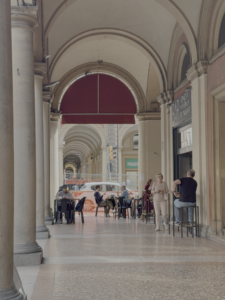
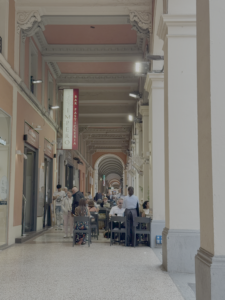
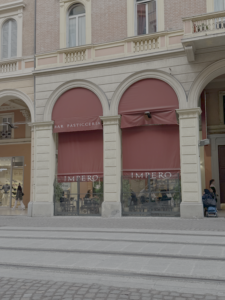
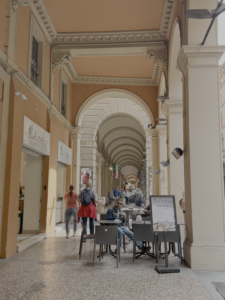
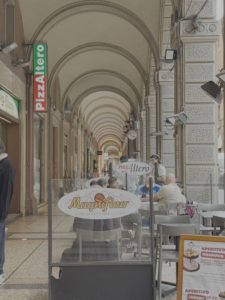
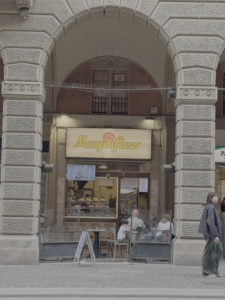
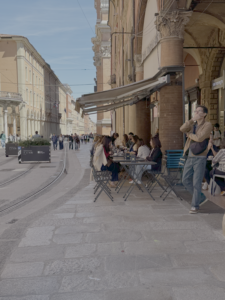
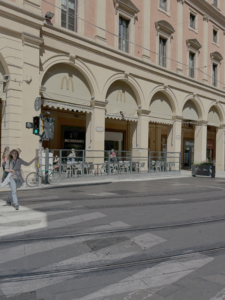
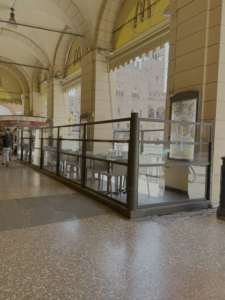
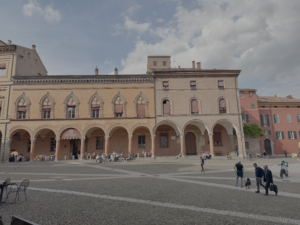
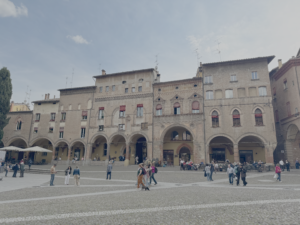
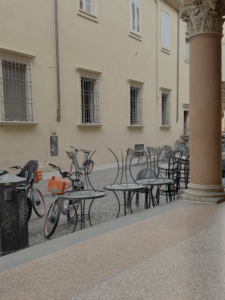
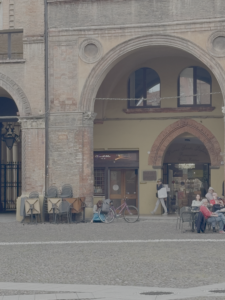
After spending so much time walking underneath Bologna’s porticoes, I began to wonder whether the spaces were public or private. Technically, anyone can walk underneath the porticoes, but not everybody is able to remain in these spaces comfortably without participating in consumption. For example, if you want to sit down while walking through Via Dell’Indipendenza, the easiest way to do so is by buying something. Seating underneath the porticoes is almost always connected to restaurants, cafés, bars, or gelato shops. But if you are shopping at H&M or Zara, or grabbing a kebab from one of the many kebab shops along the street, there is usually nowhere to actually sit.
The porticoes remain public walkways, but much of the space underneath them increasingly feels tied to commercial and consumption activities. But cafés and restaurants are part of what gives Bologna its social atmosphere. So how do we encourage people to continue existing in public spaces without needing to purchase something?
To see more from Bologna, check out the gallery, where I have uploaded pictures captured throughout the semester.
